Prosciutto di Parma PDO is not just one of the world's most loved cured meats: it is the result of more than two thousand years of history, a truly unique territory, and one of the strictest production codes in Europe.
The origins: a legacy from the Romans
The tradition of salting and curing pork legs in the area south of Parma is documented as far back as Roman times. As early as the 2nd century BC, the historian and statesman Cato the Elder described, in his treatise De Agri Cultura, the curing of hams in Cisalpine Gaul — the area that includes today's province of Parma. The Gauls, even before the Romans, had likely introduced salting techniques using salt from nearby salt pans, while the Greeks and Phoenicians spread the trade around the Mediterranean.
In the centuries that followed, ham curing became an established craft among Emilian farming families: every winter, as the cold arrived, pigs were slaughtered and the legs salted, taking advantage of the dry, well-ventilated climate of the hills south of the city.
From the Middle Ages to the founding of the Consortium
As early as medieval times, the municipal statutes of Parma regulated the work of the "beccai" (butchers) and the sale of salted meats. But it was between the 19th and 20th centuries that production shifted from a farming tradition into a true food industry, thanks above all to advances in curing techniques and the rise of the first specialised producers in Langhirano, in the heart of the production area.
In 1963 the Consorzio del Prosciutto di Parma was founded, with the aim of protecting the product and defining its production rules. European recognition as a Protected Designation of Origin (PDO) followed in 1996, with an EU regulation confirming at community level what the Italian production code had already established since 1970.
The production rules, in brief
Few food names are governed by such precise rules. Here are the main points:
- Production area: curing may only take place in a delimited part of the province of Parma, south of the Via Emilia, between the Enza and Baganza rivers, at an altitude of no more than 900 metres.
- Approved pig breeds: only certain traditional breeds (Large White, Landrace, Duroc) or their crosses, raised to precise genetic and dietary standards across ten regions of central-northern Italy.
- Minimum weight and age: pigs must be at least nine months old, and fresh legs must weigh at least around 12-13 kg.
- Just one ingredient: sea salt. No preservatives, no nitrites, no smoking.
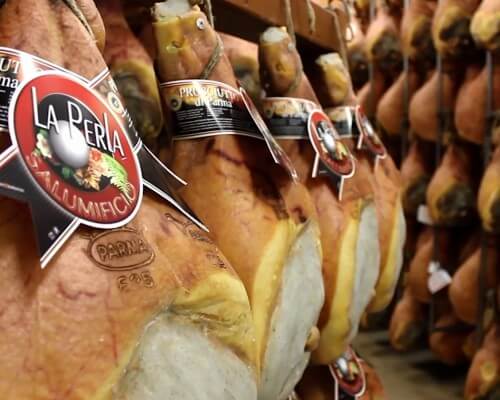
- Minimum curing time: twelve months, which can extend to eighteen months or more for the finest, heaviest hams (the "Riserva").
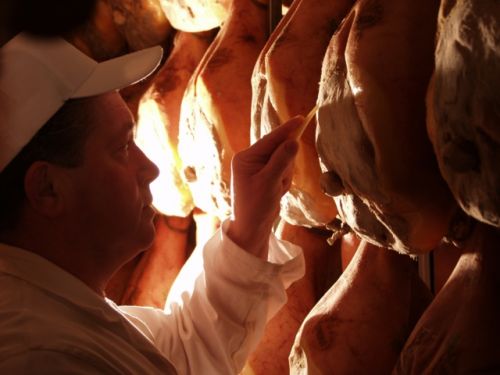
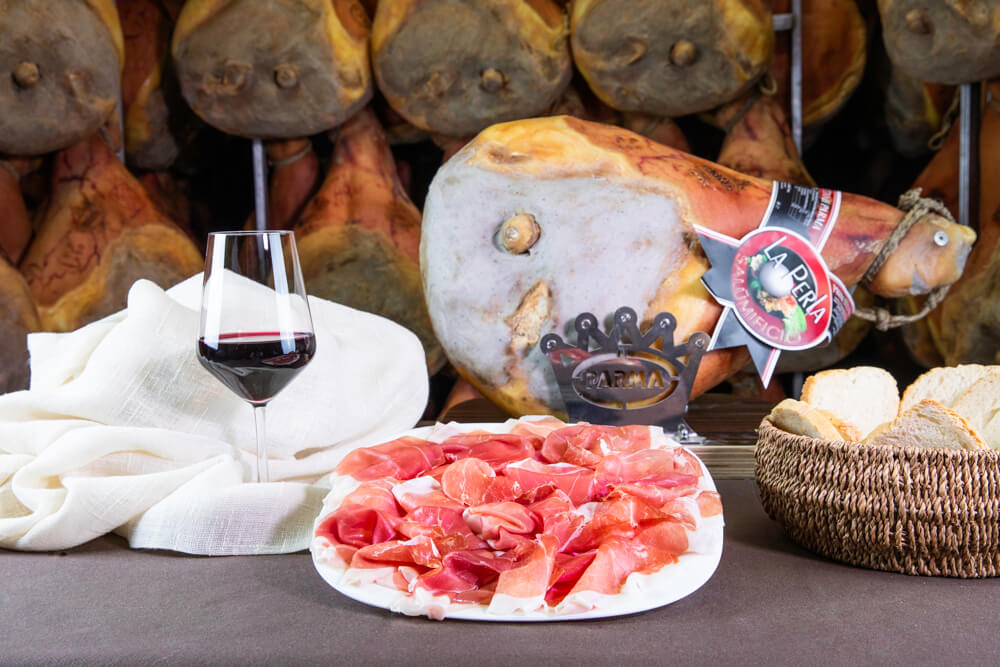
- Branding: only hams that pass every inspection — including the famous horse-bone needle test — receive the five-pointed ducal crown, fire-branded onto the rind as an unforgeable guarantee of authenticity.
A tradition that continues
Every slice of Prosciutto di Parma tells a very long story: that of a territory, of an unrepeatable microclimate — where air flowing down from the Apennines mixes with air rising from the sea — and of generations of families who have passed down the same artisan patience.
At our facility in Langhirano, we carry on this tradition every day, with the same respect for time and for the raw ingredient that has made Prosciutto di Parma PDO famous around the world.